Should Your Brand Be Funny? A Practical Guide to Humor on Social Media

Let me start with something that might take some pressure off:
Your brand does not have to be funny.
It does, however, need to feel human.
Humor is one of the fastest ways to make that happen. It can interrupt the scroll, make a complicated idea easier to understand and turn an otherwise forgettable business into one people actually enjoy hearing from.
It can also make an organization look tone-deaf, confusing or painfully out of touch.
No pressure!
The conversation around humor in marketing tends to focus on brands like Wendy’s, Duolingo and other companies that have built entire personalities around being funny. Those brands are great examples, but they can also give organizations the wrong impression. You do not have to roast your competitors, put your CEO in a mascot costume or jump on every meme that appears in your feed.
In fact, I strongly recommend that most organizations do not do those things without first asking a few important questions.
The goal is not to turn every company into a comedy account. The goal is to understand how the right kind of humor can support the identity, audience and objectives a brand already has.
Why Humor Works in Marketing
Social media users understand that businesses are trying to sell them something.
They know the video has a call to action. They know the educational carousel is eventually going to lead them toward a service. They know the person saying, “Here are three things you need to know,” probably has a fourth thing available for purchase.
Audiences are not offended by marketing itself. They become resistant when the marketing feels like it is taking more than it gives.
Humor can help change that exchange.
Instead of immediately asking for attention, a funny post offers something first: entertainment, recognition, relief or a moment someone wants to share with another person. Both of the original articles provided for this topic make a similar argument. Humor can make advertising feel less like an interruption and more like content people voluntarily enjoy, while helping a business reveal the human side of its organization.
There are a few reasons this works.
Humor interrupts familiar patterns
Most business content follows a recognizable formula:
“We provide excellent service.”
“Our team is here for you.”
“Contact us today.”
There is nothing inherently wrong with those messages, but audiences have seen them thousands of times. Humor creates contrast. A surprising line, exaggerated situation or unexpected visual gives the brain a reason to pause.
Research on humor in advertising generally finds that it can improve attention, positive emotion and attitudes toward the advertisement. A major meta-analysis combined 369 correlations from previous studies and found positive effects on attention, enjoyment and attitudes toward the ad.
However, there is an important word in that sentence: advertisement.
Getting someone to like a post is not necessarily the same as getting that person to remember the company, understand the product or make a purchase.
More recent research has reinforced this distinction. Humor is generally more reliable at improving attention and attitudes toward content than it is at directly generating buying behavior.
That is a lot of research-talk to say something relatively simple:
Being memorable is helpful, but being remembered for the right reason is what matters.
Humor lowers people’s defenses
Humor can make a message feel less confrontational and less promotional.
Researchers have found that humor may distract people from immediately developing arguments against an advertisement. Rather than thinking, “Here comes another company trying to sell me something,” the viewer becomes involved in understanding or enjoying the joke.
This does not mean humor should be used to trick people. It means it can make an introduction feel more natural.
Think about meeting someone at a networking event. The person who immediately starts reciting their résumé is probably not going to be the person you remember most fondly. The person who makes an insightful, lighthearted observation about the room may have a much easier time starting a real conversation.
Social media is not all that different.
Humor creates recognition
A lot of effective brand humor is not based on a traditional joke with a setup and punchline.
It is based on recognition:
- The thing every homeowner experiences but never talks about.
- The conversation every salesperson has had.
- The feeling every parent understands.
- The strangely specific frustration everyone in a particular industry immediately recognizes.
People laugh because they feel seen.
This is one reason humor can be particularly effective with younger audiences. Platforms such as Instagram and TikTok are heavily embedded in the daily lives of younger users, and much of their online communication is built around memes, references, exaggeration and shared cultural experiences. Younger audiences also tend to recognize heavily scripted advertising very quickly.
That being said, “Gen Z humor” is not one single language. A 19-year-old college student, a 26-year-old engineer and a 29-year-old parent are not guaranteed to laugh at the same thing simply because they fall into the same generation.
The audience still matters more than the demographic label.
Humor helps people communicate with each other
People do not only share content because they want others to learn something.
They share content to say:
“This is us.”
“This reminded me of you.”
“You need to see this.”
“I thought I was the only one.”
Humor gives people social currency. Sharing the right post allows someone to express their identity, strengthen a relationship or participate in a shared experience without writing an original message themselves.
That is one of the biggest opportunities humor creates on social media. A business is no longer only communicating with a potential customer. It is creating something that customers can use to communicate with each other.
How Humor Actually Works
One of the more useful explanations of humor is known as benign violation theory.
Very simply, something becomes funny when it feels like a violation of what is normal, expected or appropriate while also feeling safe enough to enjoy.
The violation creates surprise or tension. The “benign” part assures us that the situation is harmless. Researchers studying this theory found that people experience amusement when they can interpret something as both wrong and acceptable at the same time.
Consider a manufacturer posting a video of an employee dramatically guarding a perfectly organized tool cart as though it contains national secrets.
The violation is the ridiculous seriousness being applied to an ordinary workplace object. It remains harmless because the audience understands the exaggeration.
Now imagine the company creating the same joke about an employee injury, customer complaint or recent layoff.
The violation is still there, but the safety is gone.
This is where a lot of brand humor falls apart. The company recognizes the tension but miscalculates whether the audience will consider it harmless.
Humor also fails when there is no violation at all. A brand may participate in a trend so cautiously that the content becomes technically recognizable but completely uninteresting.
The sweet spot is somewhere between confusing and predictable:
Unexpected enough to earn attention. Safe enough to enjoy. Relevant enough to remember.
The Joke Still Needs to Belong to the Brand
I have seen organizations become so focused on whether something is funny that they forget to ask whether it is useful.
Imagine that a video receives thousands of views and hundreds of comments, but almost no one can remember which business posted it.
Did it work?
Maybe. If the sole objective was reach, you could make that argument. But if the company wanted to improve product awareness, brand recognition or sales consideration, the funny content may have done very little.
This is especially important in business-to-business marketing. A 2025 study found that humor could improve attitudes toward a B2B advertisement and its brand, but the benefits weakened when the humor felt unrelated to the product being advertised.
The joke and the message should not feel like two separate pieces of content that happened to be placed next to each other.
The best brand humor usually comes from one of four places:
The product: A recognizable feature, use case, limitation or customer behavior.
The industry: Shared jargon, frustrations, misconceptions or workplace experiences.
The people: Real personalities, relationships and moments from within the organization.
The audience: A truth customers immediately understand about their own lives.
When the humor comes from one of these places, it naturally reinforces what the company does and whom it serves.
When Businesses Should Use Humor
Humor is especially valuable when the goal is to earn attention, improve familiarity or make an organization feel more approachable.
To introduce the people behind the organization
Behind-the-scenes videos, workplace characters, employee interactions and self-aware observations can show that real people exist behind the logo.
This is not about forcing the shyest accountant in the building to perform a choreographed dance. Sometimes the funniest and most human content is simply an employee reacting honestly to something that happens every day.
To dramatize a customer frustration
A minor frustration can become an effective comedic premise because the audience already understands the problem.
A software company might exaggerate the experience of using six programs to complete one task. A contractor might dramatize what happens when a “quick weekend project” begins. A manufacturer might portray the difference between what someone thinks “custom” means and what the job actually requires.
The company is not making fun of the customer. It is joining the customer in making fun of the problem.
To make education easier to consume
Humor can help turn a technical or dry subject into approachable content.
A financial organization can use a recognizable scenario to introduce budgeting. A safety company can exaggerate a bad shortcut before explaining the correct procedure. An agency can dramatize an approval process before sharing a better workflow.
The information still needs to be accurate. Humor is the delivery method, not a replacement for substance.
To participate in a timely conversation
Trends, cultural moments and breaking events can create opportunities for brands to contribute something timely.
However, successful real-time marketing is rarely as spontaneous as it appears. Tempesta Media points to Oreo’s famous response during the 2013 Super Bowl blackout, but the company’s social team had already spent considerable time building its strategy and publishing rhythm. The quick joke worked because the systems and brand voice existed before the moment arrived.
This is an important point for organizations that look at a successful trend and say, “Why can’t we do that?”
You can—but only if your team has enough trust, clarity and authority to move while the trend is still relevant.
When Businesses Should Not Use Humor
Humor should not be treated as a reflex.
There are times when a direct, compassionate or factual response is far more valuable than a clever one.
I would be extremely cautious about humor involving:
- Death, tragedy or active community crises.
- Employee layoffs or serious workplace disputes.
- Customer injuries, medical situations or financial hardship.
- Unresolved complaints or service failures.
- Safety instructions where the joke could obscure the required action.
- Protected groups, stereotypes or people with less power than the brand.
- Serious apologies.
The biggest question is not, “Could someone be offended?”
Almost any sufficiently large audience will contain someone who dislikes a joke.
A better question is:
Does the humor minimize a real person’s pain, dignity or concern?
Humor should generally punch inward, upward or toward a shared inconvenience. It should not punch down.
Self-awareness is usually safer than superiority. A company joking about its own quirks is very different from a company making customers feel foolish for not understanding its product.
Timing also matters. A joke about a minor inconvenience may become inappropriate if the audience is experiencing that inconvenience as a serious current problem.
When in doubt, choose empathy over cleverness.
Your Brand Does Not Have to Be a Jester
Brand archetypes are useful because they help organizations define the role they want to play in customers’ lives.
The Jester is the archetype most commonly associated with humor, but every archetype can be funny. The difference is in why the humor exists, how it is delivered and where its boundaries sit.
Humor should sound like the brand—not like the social media manager borrowed another company’s personality for the afternoon.
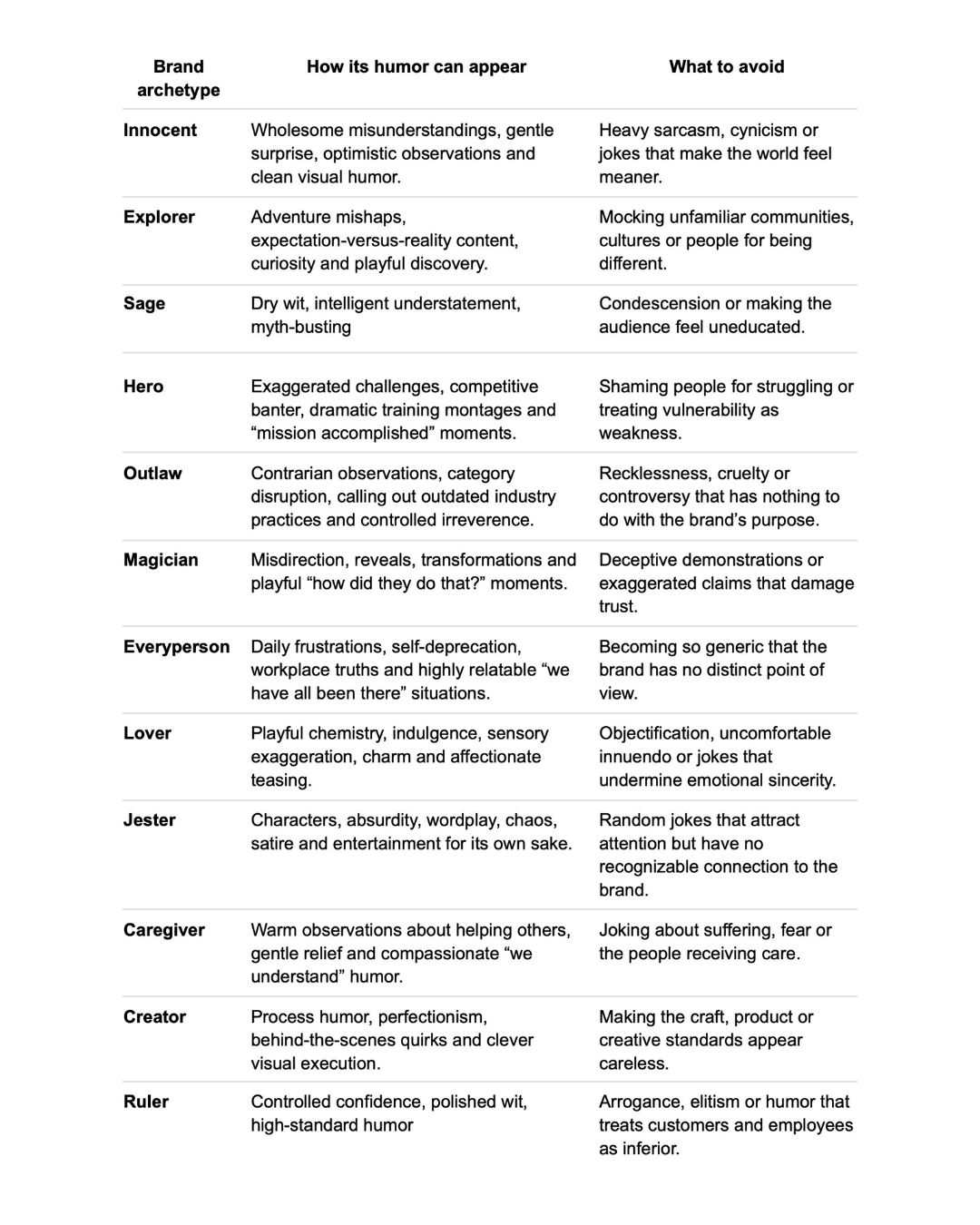
A hospital and a sports bar can both use humor. They should not use the same humor.
A financial institution and an outdoor apparel company can both use a meme. They should not use the same meme in the same way.
Research has found that different kinds of humor can influence whether audiences interpret a company as warm, competent or some combination of the two. That reinforces why the comedic style should support the perception the brand is trying to build.
Humor on Facebook
Facebook remains a broad, multigenerational platform in the United States. That creates a significant opportunity for reach, but it also means humor often needs enough context to work across a wider range of ages and levels of internet fluency.
Facebook humor tends to work well when it is:
- Rooted in community, family, work or everyday life.
- Understandable without deep knowledge of a niche trend.
- Easy to tag someone in or share with a friend.
- Connected to local culture, nostalgia or a common experience.
- Featuring recognizable people from the organization.
A local business may have more success with a video about a universal Wisconsin winter experience than with a highly specific meme format that peaked on TikTok three days earlier.
The platform also gives brands room to develop a little more context. The caption can contribute to the joke, comments can extend it and community members can add their own stories.
Meta explains that Facebook and Instagram recommendations consider signals such as the type of content, prior interactions, popularity and recency when predicting what an individual will find relevant. Humor is not an automatic algorithm trick. It works when it causes the right audience to meaningfully interact with the content.
What this means for businesses: On Facebook, prioritize accessible recognition over internet obscurity. Make something people can understand, relate to and send to someone else.
Humor on Instagram
Instagram is visual first.
The audience should be able to recognize the comedic premise almost immediately, particularly in a Reel. The first visual, first line of text or first reaction needs to establish why someone should keep watching.
Useful formats include:
- Short sketches and point-of-view videos.
- Expectation-versus-reality Reels.
- Branded memes.
- Carousels with escalating observations.
- Visual reveals.
- Story polls, sliders and informal reactions.
- Repeated characters or episodic concepts.
Instagram creates an interesting tension for brands. The content needs to feel native and human, but the platform still places value on visual identity. A grainy, spontaneous video may work beautifully, but it should still feel intentionally connected to the brand publishing it.
This is where companies sometimes confuse “authentic” with “careless.”
Humor can be casual without being off-brand. A recognizable editing style, type treatment, recurring employee, setting or comedic structure can help funny content build brand recognition over time.
What this means for businesses: Design the joke visually. Make the first frame do real work, and create something people will want to send privately—not only something they may tap “like” on while scrolling.
Humor on TikTok
TikTok is an entertainment environment before it is a marketing environment.
That does not mean businesses cannot sell there. It means the content must earn the right to sell by first understanding how people communicate on the platform.
TikTok’s own guidance encourages brands to use trends, memes and challenges when they are relevant. It also recommends a clear content structure: establish a hook, communicate the selling point and end with an appropriate call to action.
Humor on TikTok tends to favor:
- Strong characters.
- Fast escalation.
- Specific points of view.
- Employee personalities.
- Self-aware editing.
- Sounds used with an original brand application.
- Responses to comments.
- Intentionally imperfect or low-production execution.
- Highly specific audience observations.
The biggest mistake brands make on TikTok is copying the surface of a trend without understanding the underlying joke.
Using the same sound does not mean you are participating in the same conversation.
Before adopting a trend, ask:
What does this format communicate? Why are people finding it funny? What would our audience expect the final beat to be? How can our product, people or industry create a variation rather than a copy?
TikTok’s Creative Center exists specifically to help marketers review trending formats, hashtags and examples of high-performing creative. That can help teams distinguish an emerging format from one that has already been thoroughly exhausted.
What this means for businesses: Do not simply place your brand inside a TikTok trend. Find the intersection between the trend’s logic and a truth your brand is uniquely positioned to tell.
Humor on LinkedIn
LinkedIn may be the most misunderstood platform in this conversation.
Professional does not have to mean personality-free.
People on LinkedIn are still people. They experience awkward meetings, confusing jargon, impossible deadlines, strange industry conventions and the emotional roller coaster of working with other human beings.
That creates a lot of comedic material.
The difference is that LinkedIn humor generally works best when it reveals an insight about work, leadership or an industry. The humor earns attention, but the observation gives the content professional value.
Strong LinkedIn humor can include:
- Workplace satire.
- Industry-specific observations.
- Self-aware leadership stories.
- Gentle criticism of corporate jargon.
- Sales and marketing frustrations.
- Behind-the-scenes team dynamics.
- Exaggerated depictions of inefficient processes.
- “Things only people in this profession understand” content.
Humor has become more visible on LinkedIn as the boundary between personal and professional content has loosened. However, the platform still centers professional knowledge and relationships.
That means a random meme may receive reactions but do very little to establish credibility. A funny observation that leads to an intelligent point of view can accomplish both.
LinkedIn and Edelman’s research on B2B thought leadership has also shown that valuable professional content can influence how decision-makers understand problems and evaluate potential vendors. Humor should make that expertise easier to enter, not replace it.
What this means for businesses: On LinkedIn, use humor to open the door to expertise. Make people laugh because the observation is true, and then give them something useful to think about.
A Simple Test Before You Publish
Before a humorous post goes live, I would encourage your team to answer six questions:
1. Who is supposed to find this funny?
“Everyone” is not an audience.
2. What truth is the humor built around?
The strongest brand jokes normally contain a recognizable customer, employee or industry truth.
3. Does the humor fit our archetype and established voice?
Would this feel natural coming from the brand anywhere else?
4. Is the product, service or organization meaningfully connected?
Will people remember who told the joke?
5. Who or what is the target?
Shared frustrations and self-awareness are safer than making vulnerable people the punchline.
6. What happens if the joke is misunderstood?
Can the brand confidently explain the intention without becoming defensive?
If the only defense is, “People are too sensitive,” I would probably head back to the drawing board.
So, Should Your Business Use More Humor?
Probably—but thoughtfully.
Humor is not a content strategy by itself. It is a communication tool.
It can make a Sage feel less intimidating, a Ruler feel more human, a Caregiver feel more relatable and a Hero feel more entertaining. It can introduce new audiences to an unfamiliar company and give existing customers another reason to feel connected to it.
But the objective should never be to prove that the business can make jokes.
The objective is to communicate something meaningful in a way people are more likely to notice, enjoy and remember.
My professional opinion is that the brands best positioned to use humor are not necessarily the funniest ones. They are the ones that understand themselves, understand their audiences and give their teams enough room to communicate like real people.
You do not need to become Duolingo.
You do need to know what your version of being human looks like.
Research Referenced
The article incorporates the two resources provided on humor psychology, Gen Z, brand humanization, topical humor and audience alignment.
Additional research includes academic work on humor’s effects in advertising, benign violation theory, B2B humor, brand warmth and competence, and current platform behavior and creative recommendations.
Platform guidance and audience context were drawn from Meta, TikTok for Business, Pew Research Center, LinkedIn/Edelman research and reporting on the development of humor within LinkedIn’s professional culture.